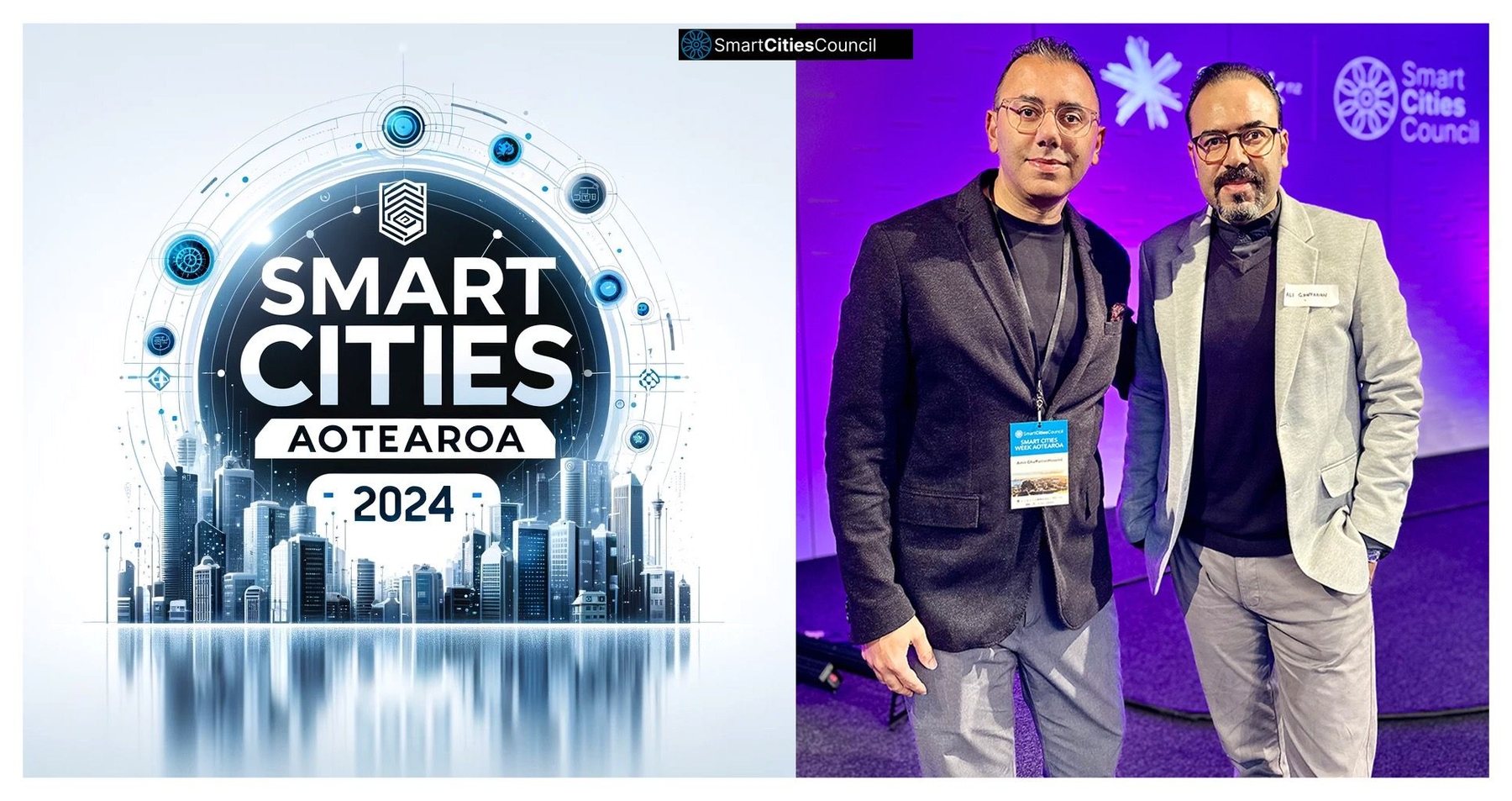
A National Forum on Urban Intelligence
Smart Cities Week Aotearoa brings together industry, local government and academia to ask how New Zealand’s cities can use data and technology to become more resilient and liveable. The 2024 edition, organised by the Smart Cities Council, ran on 27 and 28 May in Auckland. Speakers included Spark New Zealand, the Mayor of Auckland’s office at Auckland Council and Tourism Holdings, and the event was supported by AUT alongside Spark, Beca, Amazon Web Services, Christchurch City Council and Auckland Council. Across two days the programme covered:
- Lower carbon and healthier buildings, from the New Zealand Green Building Council
- A city centre digital twin, from Beca and Eke Panuku Development Auckland
- Systems thinking for climate resilience
- Digital technologies for resilient urban development
- AI in digital twins, from WSP
- The future of urban mobility
- Interactive healing environments, from AUT
The Keynote Address
Professor Ghaffarian’s keynote, delivered with Professor Amirhosein Ghaffarianhoseini, brought the university’s research perspective to an audience of practitioners and public officials, and the RG UBE Lab recorded it in its report of the week. The setting suited the questions at the centre of Prof Ghaffarian’s research on Auckland: why a city with strong digital public services can still slide in international smart city and liveability comparisons such as the IMD Smart City Observatory, and what it would take to turn data into decisions residents actually feel, in housing, congestion and access to services.
A university keynote in this setting does a particular job. The decisions that make cities smarter are spread across councils, transport agencies, utilities, telecommunications companies, developers and consultancies, and none can deliver a smart city alone. A researcher can take a longer view than any single agency, draw on international evidence and name the questions that commercial and political cycles tend to postpone: who owns urban data, how digital twins should be governed, and whether investment is reaching the problems residents care about most. Prof Ghaffarian’s account of the week placed the keynote in exactly that role. Delivering it jointly with Professor Amirhosein Ghaffarianhoseini, a research partner of more than a decade, also presented the forum with the combined voice of a research group rather than a single academic, which is how evidence on urban systems is in fact produced.
A Decade of Smart City Scholarship
Prof Ghaffarian came to the platform with a smart city record built over more than a decade. His early review of the essence of future smart houses, cited 240 times, argued that embedding information technology was not enough without adapting to sustainability principles. His jointly authored critical exposition of intelligent or smart cities and buildings in Intelligent Buildings International examined how those terms were being used and proposed a way forward. More recently, his group has reviewed the potential of digital twin technology for SDG 11 in New Zealand and the uptake of city information modelling, the urban scale counterpart of BIM.
The research has been funded and applied. Prof Ghaffarian led AUT funded work defining the smart city characteristics of significance to New Zealand (NZD 35,000, 2021 to 2022), extended in 2024 to urban revitalisation in Auckland (NZD 25,000). A parallel programme on smart mobility and freight decarbonisation ran from a national plan for decarbonising heavy freight to an externally funded total cost of ownership study for Ara Ake, including Smart Mobility as a Sustainability Enabler for New Zealand (NZD 50,000, 2023). The work is carried by the RG UBE Lab, which Prof Ghaffarian founded with Professor Amirhosein Ghaffarianhoseini in 2014 as a research consortium based in New Zealand, Canada and Malaysia, working at building and urban scales on building intelligence, digital twins, urban microclimate, mobility innovation and artificial intelligence. At the time of the keynote, Prof Ghaffarian was Head of Department of Built Environment Engineering and also led AUT’s Smart Cities and Infrastructure Research Cluster, a role relinquished only on appointment as Head of School.
Public Argument and Policy Reach
The keynote belongs to a wider body of public argument. In June 2024, weeks after the forum, Prof Ghaffarian and Professor Amirhosein Ghaffarianhoseini published in Architecture Now on how Auckland’s new urban plan could forge a smart, sustainable future. Related commentary on this site sets out why Auckland needs to become smarter, why the city needs fifteen minute lives rather than imported models and how smart mobility can enable sustainability. The consistent claim is that a smart city is measured by the lives of its residents, not by the volume of its sensors.
That claim also informs Prof Ghaffarian’s advisory work. As a member of the Artificial Intelligence Reference Group at the Office of the Prime Minister’s Chief Science Advisor since 2023, and as an evaluator for MBIE since 2022, Prof Ghaffarian contributes to decisions about how public research money and national thinking on AI address the built environment. A keynote to practitioners and officials at a national forum is the public face of the same expertise, and it allowed the argument to reach decision makers directly rather than through the slower channels of publication.
From Forum to Lasting Partnership
The relationships visible at Smart Cities Week carried forward into the conferences Prof Ghaffarian went on to lead. The Smart Cities Council provided one of the twelve keynotes at SASBE 2024, which he chaired at AUT six months later, and joined the inaugural GDI conference in December 2025 as a partner body. Beca, which presented a city centre digital twin with Eke Panuku at the forum, became primary partner and sponsor of GDI 2025 and hosted its opening day. The NZGBC, which spoke on lower carbon and healthier buildings, provided keynotes at both SASBE 2024 and GDI 2025.
The pattern illustrates how Prof Ghaffarian builds platforms. A keynote at another organisation’s forum establishes credibility with its community; that credibility becomes a keynote, a partnership or a sponsorship in a conference AUT leads; and the conference in turn produces proceedings, special issues and student opportunities. Smart Cities Week Aotearoa 2024 was an early link in a chain that, by the end of 2025, connected the School of Future Environments with New Zealand’s smart city community at the level of its leading organisations.