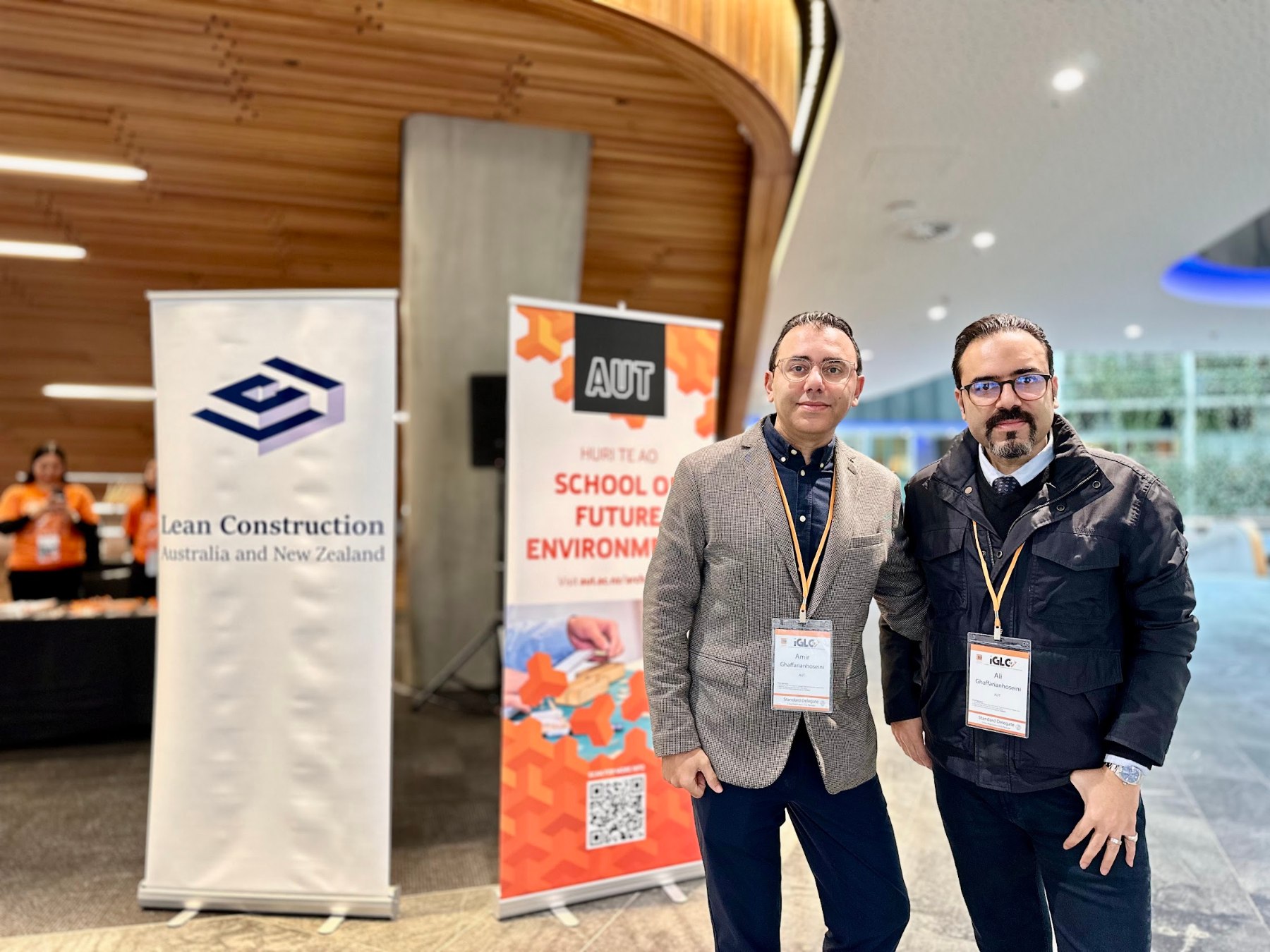
Lean Construction Arrives in Aotearoa
The International Group for Lean Construction brings together researchers and practitioners who apply lean production thinking to the design and delivery of buildings and infrastructure. Its 32nd annual conference, IGLC32, came to AUT City Campus from 1 to 6 July 2024, the first time the series had been held in New Zealand. The programme opened with an Industry Day on 1 July, followed by a workshop day with a Gemba walk, three days of technical conference and a PhD School on 6 July, whose dean came from Aarhus University in Denmark. Keynotes came from Professor Glenn Ballard of the University of California, Berkeley, one of the founders of IGLC, and from Kāinga Ora. Lean Construction Australia and New Zealand jointly hosted the conference.
Opening and Closing the Technical Conference
Professor Ghaffarian formally opened the Technical Conference on 3 July 2024, after the Industry Day and the workshop day, and delivered the closing address that brought the conference to an end. Both addresses were recorded by the RG UBE Lab and are published here, which makes them part of the permanent public record of the conference rather than remarks remembered only by those in the room. The opening welcomed an international community to the first IGLC held in New Zealand on behalf of the host; the closing spoke on behalf of the host university at the moment the community prepared to leave, the point at which a host’s judgement of what has been achieved carries most weight.
The two addresses framed the scientific core of the week, in which lean construction research from across the world was presented in Auckland. For a community that has met annually for more than three decades, an inaugural visit to a new country is an occasion of some consequence, and the host’s voice at its opening and close determines how the host institution is remembered. Prof Ghaffarian’s task was to present AUT as a credible long term partner of the international lean community rather than a one time venue, and to connect the conference with the New Zealand industry that would carry its ideas forward.
Leadership of the Host Department
Prof Ghaffarian led Built Environment Engineering as Head of Department from 2020 to 2026. The department delivers AUT’s BE (Hons) in Architectural and Construction Engineering, the Bachelor of Construction, the Master of Construction Management, the Master of Engineering Project Management and the Master of Engineering, degrees that prepare the engineers and construction managers who apply lean methods in practice. Hosting IGLC32 placed those programmes, their staff and their doctoral candidates in front of the international field, and gave students direct access to the people whose methods they study. The credibility of that offer rested on the department’s standing: Prof Ghaffarian had directed the Architectural Engineering major through its first Engineering New Zealand accreditation in 2018, recognised internationally under the Washington Accord, and led the department’s accreditation working group in 2021. The PhD School that closed the week also suited a host with a substantial doctoral record; Prof Ghaffarian has supervised 21 completed PhD theses and currently supervises 13 candidates.
The conference was delivered by a chairing team led by Dr Mani Poshdar, with Professor Amirhosein Ghaffarianhoseini, Professor Charles Walker and Janie van Woerden, and it was the departmental platform Prof Ghaffarian provided that made a six day international programme possible. Sponsors and contributors included Lean Construction ANZ, Argon & Co, McConnell Dowell, Implenia, Beca and the Chartered Institute of Building. IGLC32 was also one of three international conferences, with SASBE 2024 and GDI 2025, through which Prof Ghaffarian’s leadership generated substantial external income for AUT and raised the University’s international academic profile.
The Productivity and Carbon Case
AUT’s own account of the conference noted that the built environment accounts for between 15 and 20 percent of New Zealand’s greenhouse gas emissions. Lean methods make projects easier to manage, safer, faster, cheaper and of better quality, and so they carry a sustainability argument as well as a productivity one. That double argument is the ground on which Prof Ghaffarian’s research meets the lean community. His review of BIM uptake, cited 1,266 times, addressed the benefits, risks and challenges of the digital process on which much lean coordination now depends, and his doctoral students have studied construction logistics, supply chain efficiency and the decarbonisation of freight.
The connection is also direct. Prof Ghaffarian jointly authored a paper at IGLC31 on lean construction waste reduction through autonomous vehicle technology, and has contributed to work on a competency framework for the digital project manager in smart construction with Dr Poshdar. AUT funded projects on dynamic scheduling in building construction and in the road and infrastructure sector extend the same agenda. As research supervisor or director of studies for 134 completed Master of Construction Management projects, Prof Ghaffarian has shaped a generation of construction managers to whom lean thinking is a working method rather than an import. Across the Master of Engineering, Master of Construction Management and Master of Engineering Project Management, 158 master’s research projects have been completed under that supervision, and more than 300 oral defence examinations conducted since 2014, a direct line from the department’s classrooms into New Zealand project delivery.
What Followed
The most tangible legacy of IGLC32 at AUT is student led. In 2025 Prof Ghaffarian led and supported the formation of the Lean Construction Student Association, which connects engineering and built environment students with peers, industry leaders and Lean Construction Australia and New Zealand through workshops, site visits and research opportunities. The association has since partnered with GDI 2025 and with the Future Environments Thought Leadership Series, including The Hard Part of AI: Lean and AI in Construction in May 2026, with speakers from Auckland International Airport and BuildBIM.
IGLC32 also opened a sequence of international hosting that defined Prof Ghaffarian’s final years as Head of Department: SASBE 2024 with CIB W116 four months later, then the inaugural GDI conference in December 2025. Each built on the operational experience of the last, and together they changed what AUT’s built environment School is known for internationally. The first IGLC in New Zealand was the moment that sequence began, and the opening and closing addresses were the moments in which the host department’s ambition was stated in public.
Gallery, recordings and documents
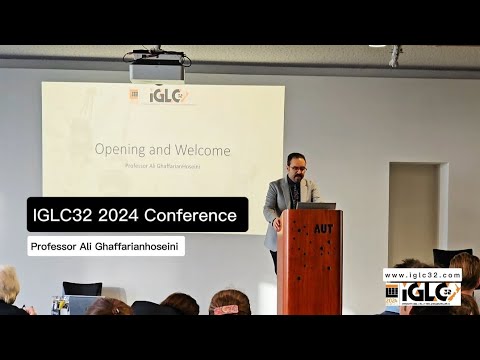 Welcome speech, video
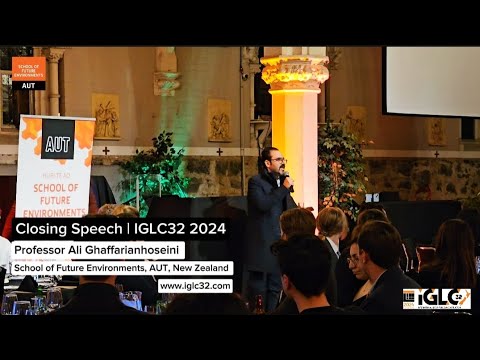 Closing speech, video
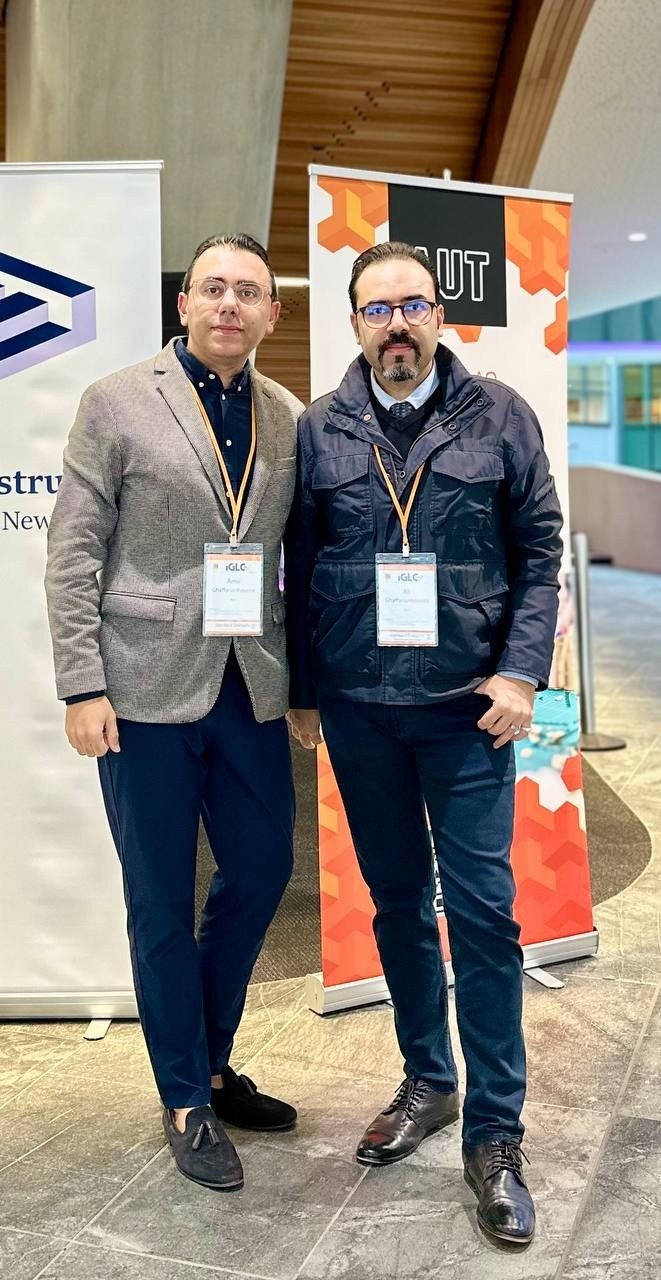 IGLC32, Auckland, 2024, with Professor Amirhosein Ghaffarianhoseini (photo: AG++ studio, Professor Amirhosein Ghaffarianhoseini)
 With Professor Amirhosein Ghaffarianhoseini and a fellow delegate at IGLC32 (photo: AG++ studio, Professor Amirhosein Ghaffarianhoseini)