The Occasion
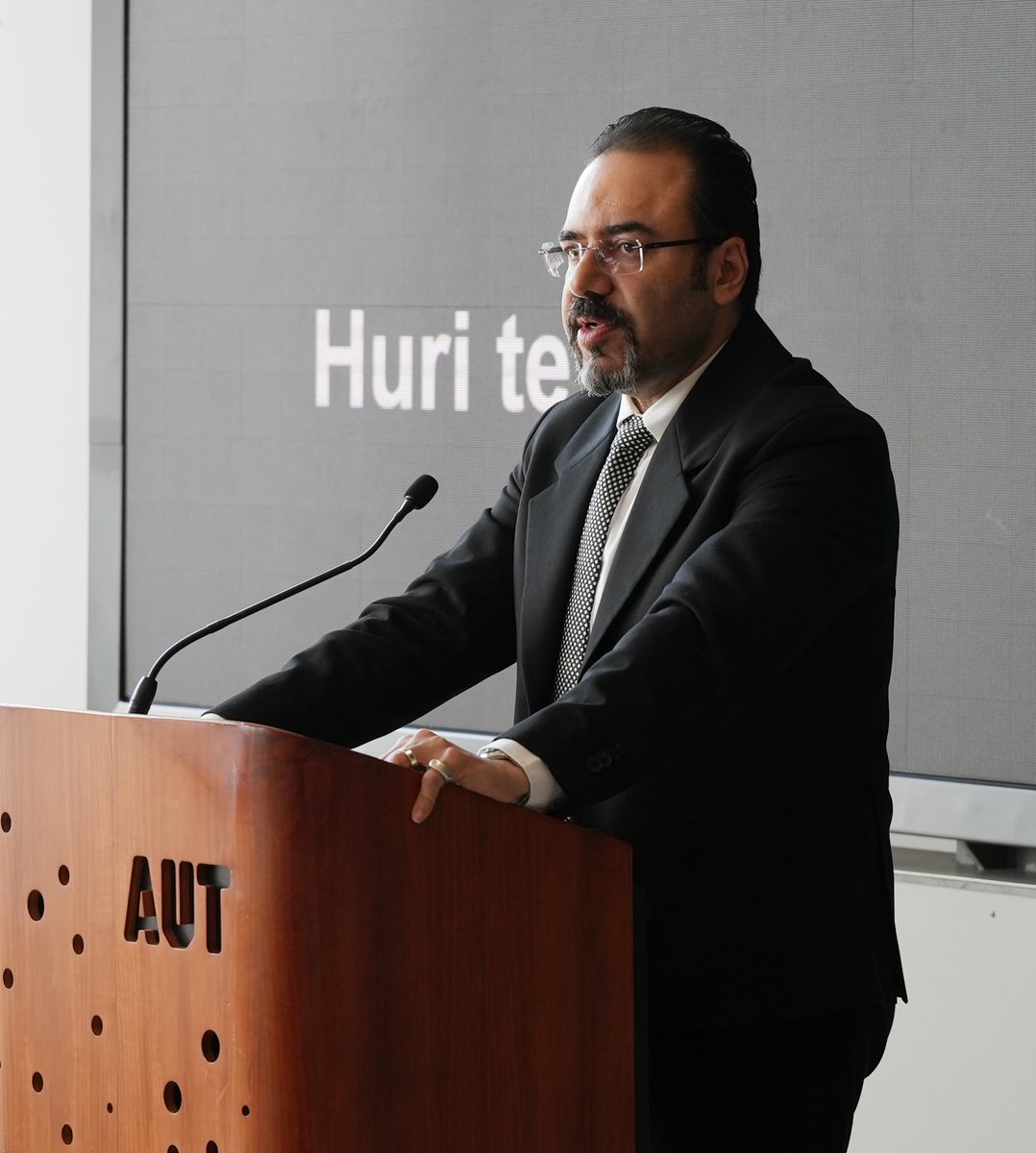
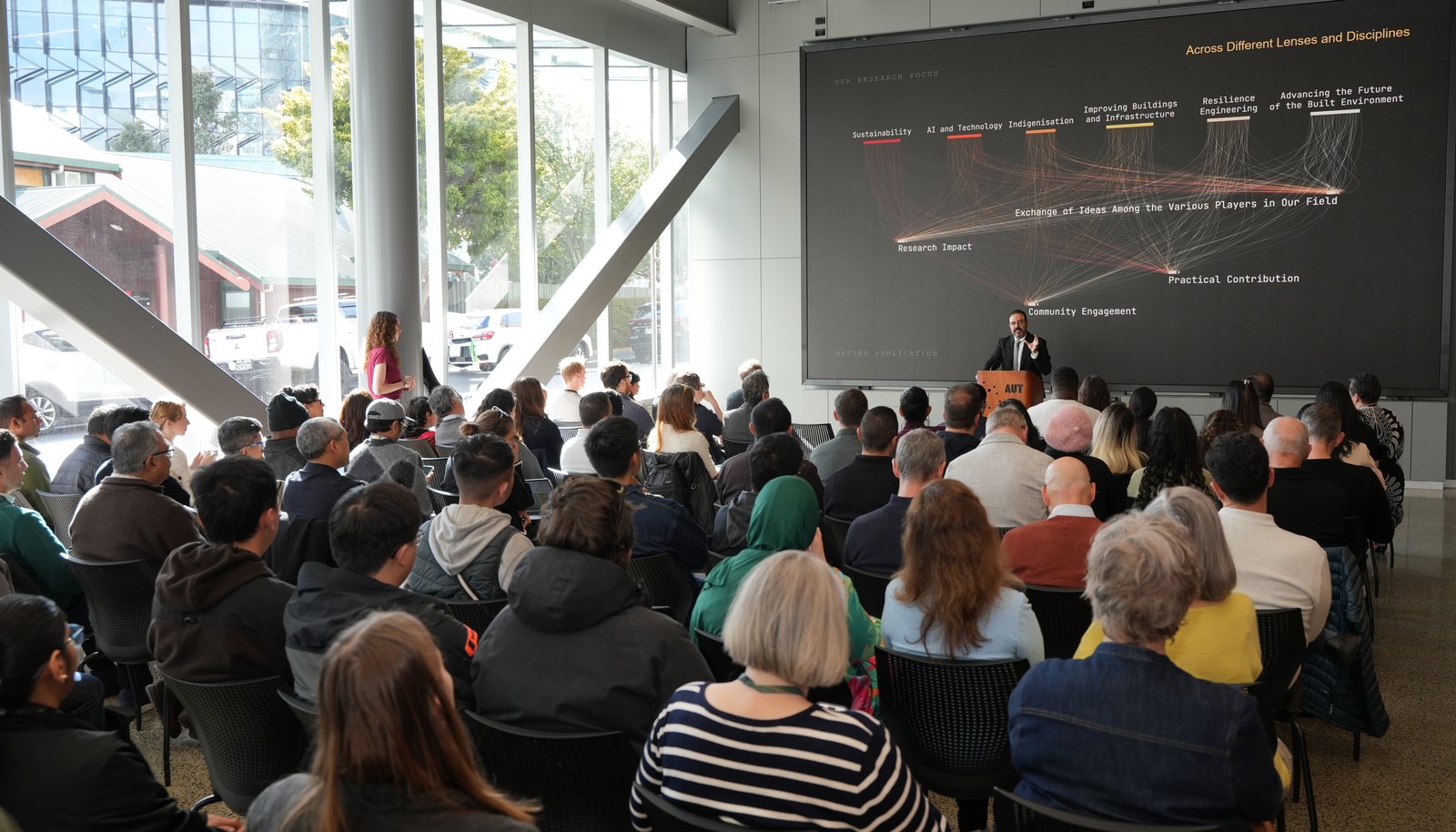
The Future Environments Research Symposium is the annual research gathering of the School of Future Environments at AUT, held as part of AUT Research Week, which in 2026 ran from 31 August to 4 September. The symposium took place on the morning of 3 September in the WZ Building on City Campus. It opened with remarks on research leadership and strategic direction from Professor Amirhosein Ghaffarianhoseini, Associate Head of School (Research), and a karakia. Seven research presentations followed, ranging from rooftop solar deployment in New Zealand and the carbon cost of office renovation cycles to resilient neighbourhoods under flood risk, Te Kura o Rata, and vibration based monitoring of ageing and earthquake damaged infrastructure. More than 200 people attended across the morning.
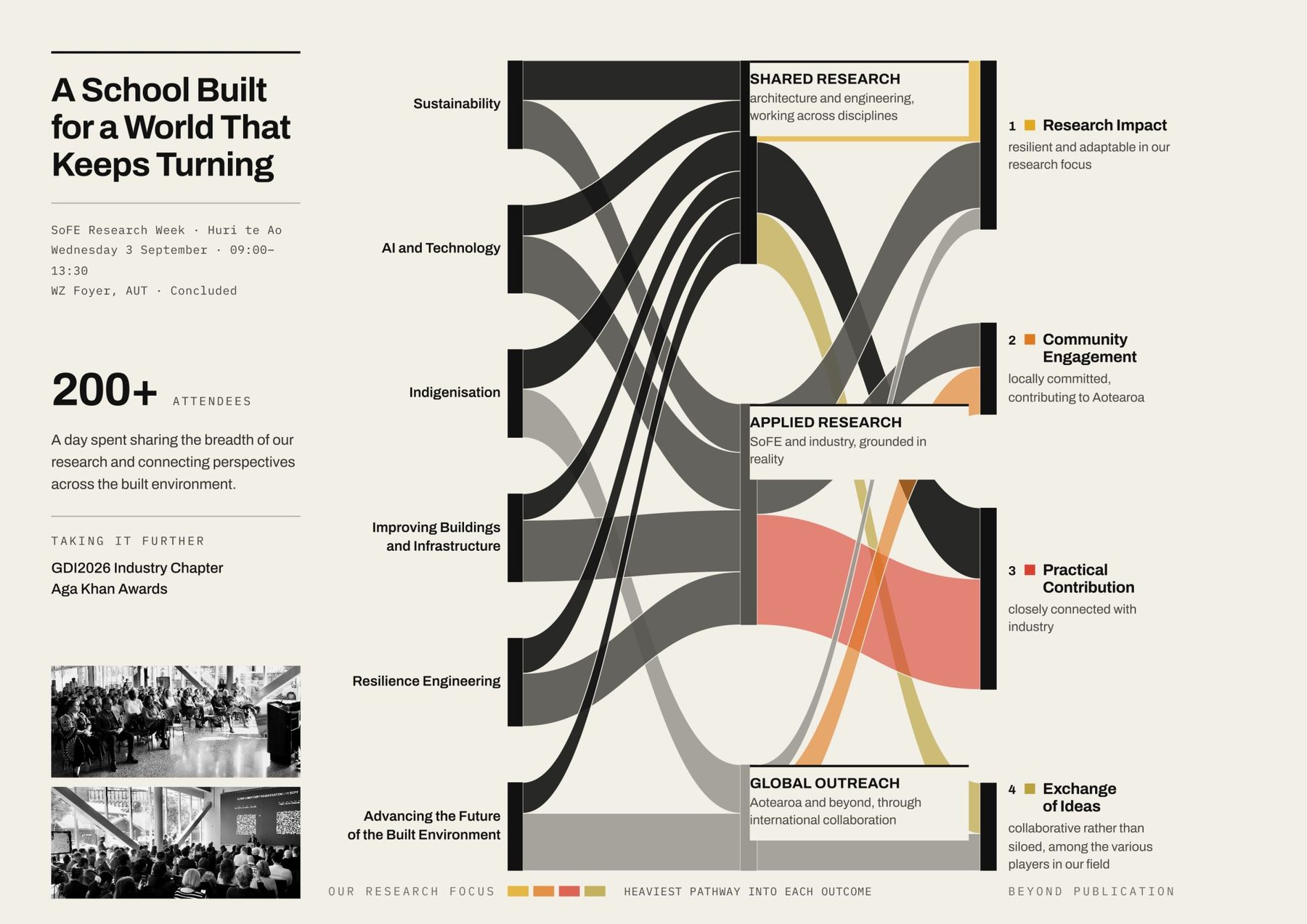
Most research showcase days end with a list of projects. Ours ended with a map.
His reflection on the symposium, LinkedIn
The Keynote Address
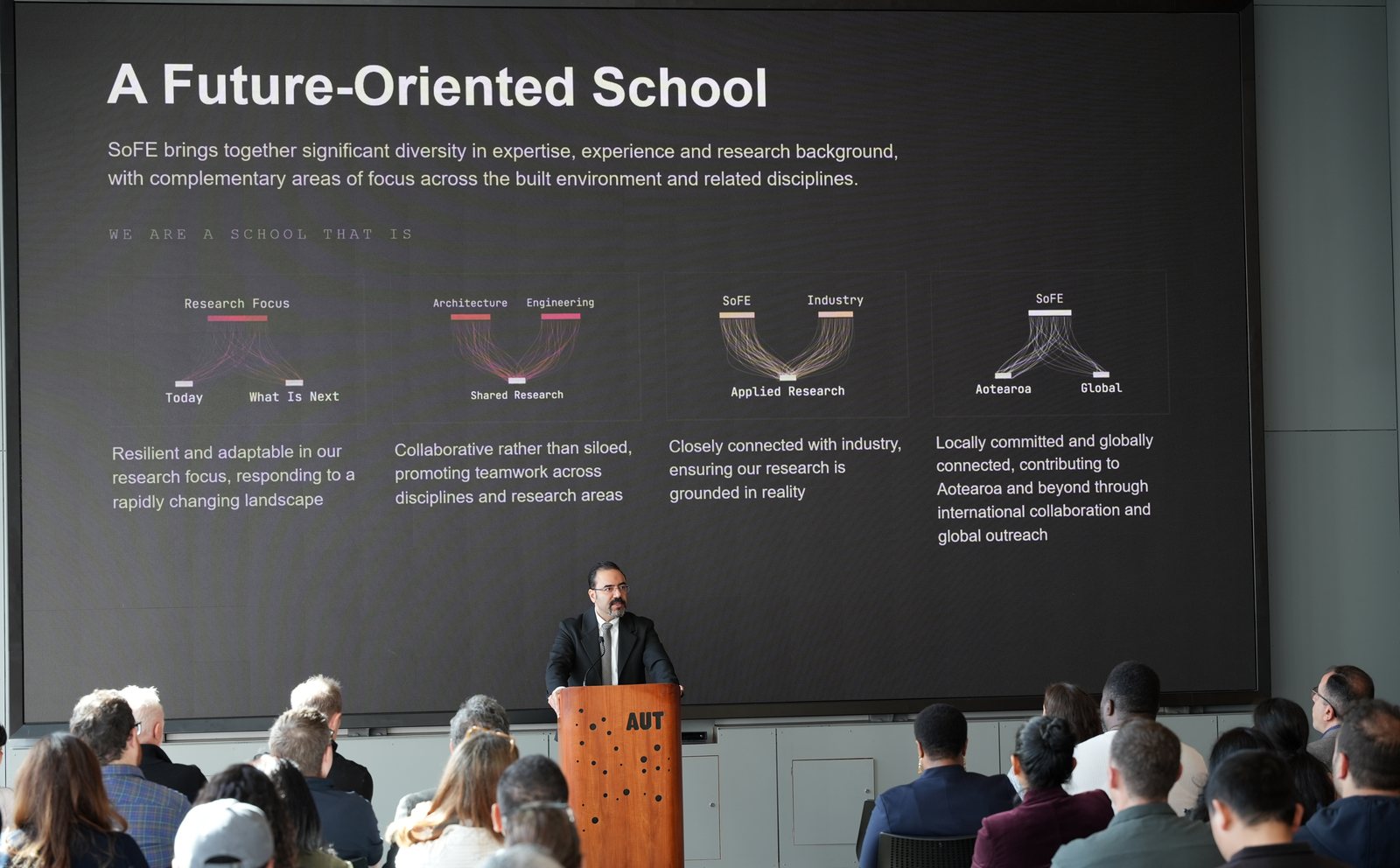
Professor Ghaffarian’s address as Head of School set out what the morning was for and how the School wished its research to be read: not as a list of projects but as a body of work with a shape and a direction. On the eve of the day, Prof Ghaffarian had described the occasion on LinkedIn as “a confident expression of who we are becoming as a school,” committed to research that speaks directly to the challenges shaping built, natural, digital and human environments. The symposium was built to make that claim visible rather than merely assert it.
The device was a map. Sustainability, artificial intelligence and emerging technologies, indigenisation, buildings and infrastructure, resilience engineering and the future of the built environment were presented as a single connected network, linking research themes to research impact, community engagement and practical contribution. In his reflection afterwards, Prof Ghaffarian drew the leadership conclusion: resilience in a school is not produced by the language of a strategy document. It comes from the depth, breadth and coherence of the research base, and from the capacity to respond to shifts in policy, funding, technology and social need while holding a clear direction. A school whose work connects in this way can absorb external shocks, because no single funding stream or policy setting holds it up.
Leadership Through Recognition
Prof Ghaffarian closed the formal programme by presenting the SoFE Research Excellence Awards 2026 and the PhD Awards 2026, with Sherif Beskhyroun, Professor Amirhosein Ghaffarianhoseini and Stacy Vallis. Awards signal what an institution values, and presenting them at the close of a morning built around connected research tied recognition directly to the kind of work the new Head of School wants to see more of. The judgement behind such recognition is one Prof Ghaffarian exercises well beyond AUT: as an independent assessor of cases for promotion to Professor and Associate Professor for universities in New Zealand, Australia, Canada, Hong Kong, Malaysia, Saudi Arabia, the United Kingdom and the United States, and as an assessor for the European Research Council, Marie Skłodowska-Curie Actions and Horizon Europe. Standards applied to international cases were here applied, publicly, to the School’s own.
The gesture rests on experience of how research cultures are made. Prof Ghaffarian leads a School of more than 100 academic and professional staff, and as Head of Department of Built Environment Engineering from 2020 to 2026 introduced structured recognition of teaching and service contributions, transparent performance review and new ways of making team achievement visible within and beyond AUT. The doctoral awards carry particular weight from a supervisor with 21 completed PhD theses and 13 current candidates, and recognised by the Faculty’s Outstanding Doctoral Award in 2020. The symposium extended that approach from the department to the whole School.
A Research Record That Sets the Standard
The authority of an opening address on research depends on the research record behind it. Prof Ghaffarian’s rests on a set of critical reviews that became reference points in their fields, from green roofs and BIM uptake to green building rating systems and urban heat island mitigation. His Google Scholar profile records more than 11,000 citations and an h index of 42 (September 2026); about two thirds of those citations have accrued since 2021, and 2025 was his highest single year, with 1,555. The point for colleagues is that the record has grown, not plateaued, through years of line leadership.
Several of the morning’s themes run directly through that record. The presentation on vibration based monitoring of infrastructure sits beside the Structural Testing Laboratory, a nationally significant facility whose design, development and operationalisation Prof Ghaffarian led. Resilience and neighbourhood climate work connect to his studies of New Zealand’s urban microclimate and to the Kaitiakitanga digital twin programme for Auckland. Rooftop solar has also reached public debate through commentary on solar affordability. The map presented on the day was therefore a description of real connections, several of them built by the person presenting it.
The connections are also financed. Prof Ghaffarian has secured more than NZD 1.5 million in New Zealand research, doctoral scholarship and conference hosting funding since 2015, across 41 awards, including 16 doctoral scholarships worth NZD 1,066,000. As leader of the Regenerative Design Research Cluster in 2020, a group whose work has been funded by BRANZ, MBIE and EQC, and later of the Smart Cities and Infrastructure Research Cluster until 2026, Prof Ghaffarian learned how research groups grow when their themes reinforce one another. The symposium translated that lesson from cluster to School: a portfolio of connected themes attracts students, partners and funding more reliably than a collection of isolated projects.
Strategic Significance for the School
The symposium was the first major research occasion of Prof Ghaffarian’s headship, and it came within months of a result that changed the School’s external standing. Under his strategy, Architecture and Built Environment at AUT entered the QS World University Rankings by Subject for the first time in 2026, in the 201 to 260 band, as one of three New Zealand universities ranked in the subject. Research reputation and citation impact are among the indicators on which that position depends, so a public account of a coherent research base was also an investment in keeping it.
The morning led directly into the GDI 2026 Industry Chapter and the Aga Khan Award for Architecture exhibition the following week. All three occasions rest on the principle Prof Ghaffarian has set for the School’s research: it matters most when it changes thinking, practice, policy or places beyond the university. Read together, they describe a Head of School using the calendar itself as an instrument of strategy, moving from internal coherence to industry engagement to international benchmark in the space of eight days.