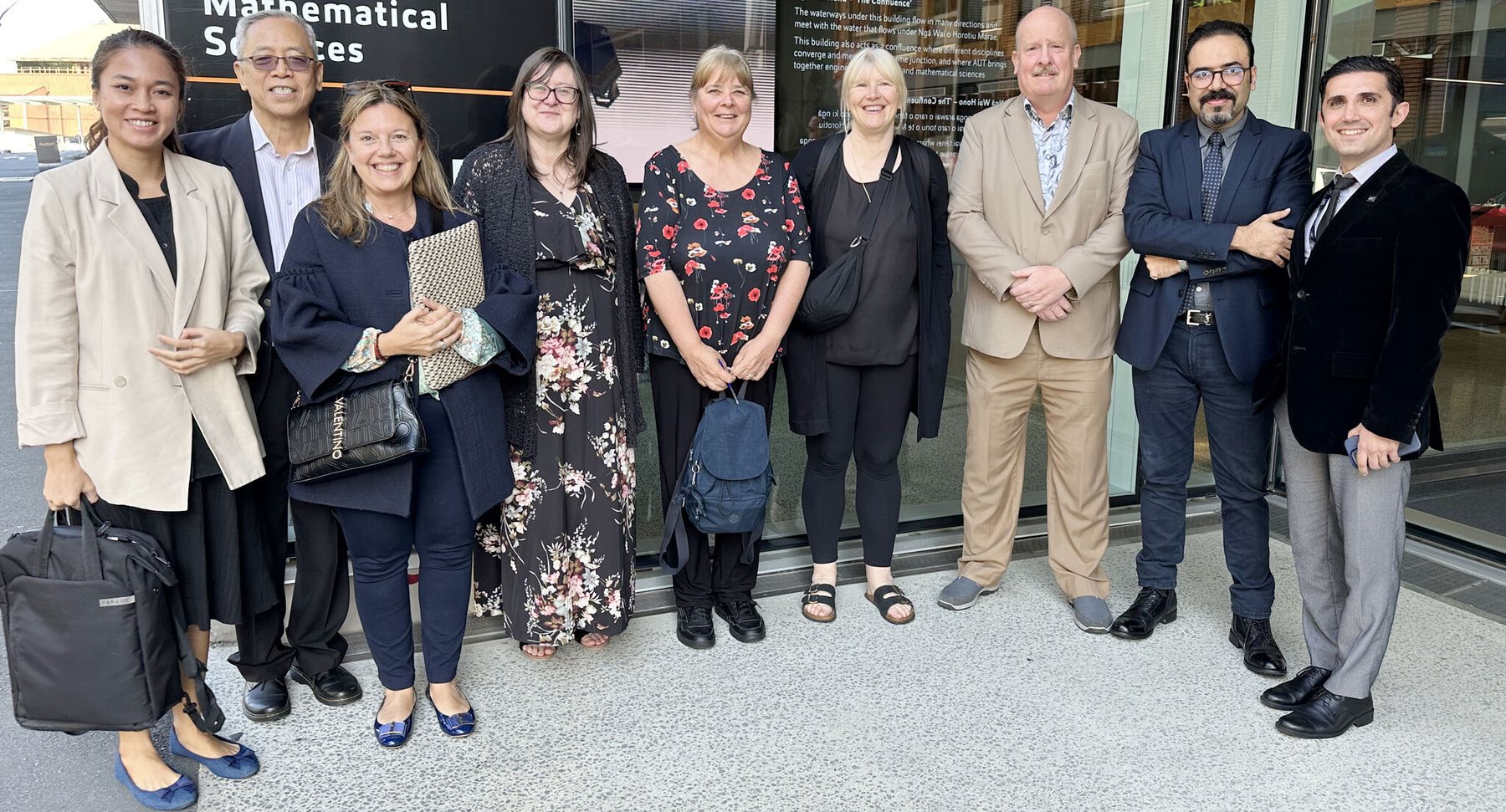
The Review
The Royal Institution of Chartered Surveyors panel came to AUT to evaluate the Bachelor of Construction majors in Construction Management and Quantity Surveying against the institution’s professional and educational standards. The visit brought together the programme team, students, employers and industry partners, and students presented their learning journeys to the panel directly. As Head of Built Environment Engineering, Professor Ghaffarian welcomed the panel and led the department’s preparation. In his public account, Prof Ghaffarian thanked the panel for its time and feedback, colleagues across the School and the University for their teamwork, and the students, employers and partners whose engagement keeps the programmes relevant to practice.
Stewardship of a Degree Built From the Ground
The panel was examining work that Prof Ghaffarian has shaped since joining AUT in 2014. The record names him as a developer of both majors under review: the Bachelor of Construction, which is accredited by RICS, and its Quantity Surveying major, which also holds accreditation from the New Zealand Institute of Quantity Surveyors. Prof Ghaffarian has also taught on the degree, leading courses in construction materials, construction technology, construction engineering management and advanced construction systems.
The panel therefore met a Head of Department with direct ownership of the curriculum under review. Prof Ghaffarian also brings an external examiner’s perspective. In 2019 Prof Ghaffarian served as external moderator for the Bachelor of Construction majors in Construction Management and Quantity Surveying at Massey University, and in 2021 chaired the external examination of the department’s own undergraduate courses. That experience shows how the same degree is taught elsewhere in New Zealand and how evidence of quality must be assembled for scrutiny.
An Accreditation Record Across Three Systems
The RICS review was one chapter in a broad accreditation record. In Malaysia, Prof Ghaffarian led the faculty accreditation working group with the Malaysian Qualifications Agency in 2013. At AUT Prof Ghaffarian led the working group that carried the Architectural Engineering major through its first accreditation with Engineering New Zealand in 2018, recognised internationally under the Washington Accord with its next review in 2028, and in 2021 led the departmental accreditation working group again. The Building Engineering and Building Services Engineering majors developed under the same leadership held Sydney Accord accreditation from 2018 to 2024.
In all, five of the AUT programmes Prof Ghaffarian developed hold or have held professional accreditation, and the work has involved eleven accrediting and professional bodies, from Engineering New Zealand, RICS, CIOB and NZIQS to NZRAB, to which Prof Ghaffarian now reports as Head of School on the Master of Architecture (Professional). A working knowledge of the Washington, Sydney and Dublin accords was built through this work rather than alongside it.
A Global Benchmark for Graduates and Employers
RICS is the global professional body for surveying and construction, and its accreditation allows graduates to progress towards chartered status recognised in many countries. For students it makes an AUT construction degree portable; for employers it is assurance that graduates meet an international benchmark; for the University it is external validation that cannot be self awarded. Reviews of this kind examine curriculum, staffing, resources, industry engagement and student outcomes, and they require a department to evidence its quality rather than assert it.
For New Zealand, where skills shortages and productivity are persistent concerns across construction, internationally benchmarked graduates are a public good as well as a private credential. A degree recognised by RICS allows AUT graduates to compete for roles abroad and allows employers at home to recruit with confidence, which is why accreditation is better understood as an obligation to the sector than as an administrative milestone.
The timing shows the scale of what the department was carrying. The review fell in the same month that Prof Ghaffarian jointly chaired SASBE 2024 with Professor Amirhosein Ghaffarianhoseini, four months after his department hosted IGLC32, the first International Group for Lean Construction conference in New Zealand, and three months after AUT joined the Associated Schools of Construction. Accreditation, international conferences and peer networks were advancing together as one strategy for the standing of AUT’s construction education.
Leadership in Practice
Preparing a department for an international panel is a leadership task that runs well beyond the visit itself. As Head of Built Environment Engineering, Prof Ghaffarian carried a portfolio that spanned academic recruitment and mentoring, departmental budget and capital planning, workload allocation, programme review and engagement with industry advisory boards. Each of those responsibilities feeds the evidence an accreditor examines: whether staffing matches the curriculum, whether resources support the learning outcomes claimed, and whether industry has a genuine voice in the programme.
The record points to an approach that treats accreditation as a continuous discipline rather than a periodic event. External and internal moderation, graduating year reviews and mentoring of academics on curriculum review and delivery strategy are, in that view, the ordinary means by which a department keeps itself ready for scrutiny at any time. The RICS visit tested that discipline in front of an international professional body, with employers and students in the room.
Students as the Evidence
Prof Ghaffarian singled out the students who joined the session for particular thanks: their ability to describe their own learning journeys left a positive impression on the panel. Accreditation is ultimately judged on what graduates can do, and students who can articulate their learning are the strongest evidence a programme can offer.
That emphasis reflects a long personal investment in construction students. Prof Ghaffarian has supervised 158 Master’s research projects to completion, 134 of them in the Master of Construction Management, and in 2025 he led and supported the formation of the Lean Construction Student Association at AUT, connecting students with Lean Construction Australia and New Zealand. The RICS panel met students formed in that culture of engagement.