A Pandemic Question for the Smart City
In November 2021, with remote work still reshaping how New Zealanders used homes and offices, Professor Ghaffarian wrote for Architecture Now with Professor Amirhosein Ghaffarianhoseini on the future of shared living and working space. Prof Ghaffarian wrote as Head of Built Environment Engineering at AUT, a role held since 2020, and placed the question within the wider idea of smart living. The term smart city, the authors observed, appears in almost every conversation about the changing built environment, yet its concrete realisation would require a cultural shift in how habitable space is conceived, allocated and used. The pandemic had turned an academic debate into a practical one for every household and employer.
Smarter living, as a key attribute of forming a smart city, would necessitate a major transition from static to dynamic spaces.
ArchitectureNow, 12 November 2021
From Static to Dynamic Space, With Discipline
The article’s central claim was that smarter living, a key attribute of a smart city, demands a transition from static to dynamic spaces, in which flexibility and a high degree of freedom become standard features of any habitable space. The claim was carefully bounded. Flexibility did not mean collapsing work into life; Prof Ghaffarian insisted that a separation between the two should remain, while recognising that in a dynamic environment their overlap cannot be ignored and should be designed for rather than left to chance. This is a design position, not a lifestyle slogan. It asks architects and engineers to plan for changing patterns of occupation at the outset, rather than retrofitting buildings each time patterns of work and household life shift.
The position extended Prof Ghaffarian’s earlier work on the essence of smart homes, a 2017 book chapter on the application of intelligent technologies towards a smarter urban future. The article carried that line of thinking from the individual dwelling to shared buildings, where the question of whether technology and flexibility genuinely serve occupants becomes a matter of design for groups and communities rather than for single households.
The authors resisted easy enthusiasm. The pandemic, they argued, had shown that spatial design must become more resilient and that designers must build the possibility of adaptation into their proposals. Social separation is a major side effect of remote work, and co living and co working can help to counter it. Poorly designed co working settings, however, can harm productivity. Before any shared office is endorsed, Prof Ghaffarian argued, a thorough feasibility study should examine the tasks being performed and the people performing them, from both design and practical viewpoints. The value of shared space depends on whether it fits the work, and that is an empirical question to be answered before investment rather than after occupation.
The Scholarship Behind the Commentary
The argument condensed more than a decade of research on intelligent and responsive environments. Prof Ghaffarian’s 2013 review of the essence of future smart houses, cited 240 times, traced the move from embedding information technology in homes to adapting them to sustainability principles. The 2016 analysis of what an intelligent building is has become the most read article in the history of Architectural Science Review, with 51,627 views on the publisher’s site, and the 2018 critical exposition of intelligent or smart cities and buildings set out a way forward for the field. Read together, these works locate intelligence in how a building responds to its occupants, which is the premise of the dynamic space the article proposed.
The concern for productivity and wellbeing had an equally strong basis. The 2018 review Sick Building Syndrome: Are We Doing Enough?, cited 373 times, examined how indoor environments harm the people who occupy them, and a 2019 paper at CAADRIA, the Computer Aided Architectural Design Research in Asia conference, had already explored how immersive technology could promote highly efficient working patterns in smart offices. The warning against untested shared offices was therefore not intuition but the position of researchers who had studied, at length, how buildings succeed and fail for the people who use them.
The Studio as Evidence
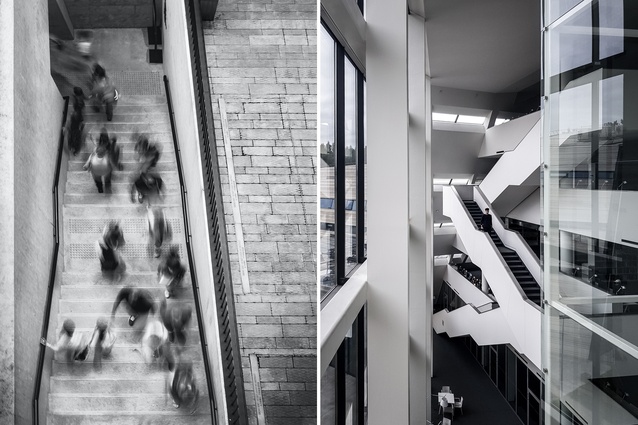
The article was illustrated by the final year design studio of the Bachelor of Engineering (Honours) in Architectural Engineering, where students designed mixed use community blocks on an Auckland city site and interpreted co living and co working in their own terms, exploring communal space, vertical connection, outdoor plazas and biophilic design. Prof Ghaffarian knew the programme from its foundations: as Programme Director he had carried the Architectural Engineering major through its first accreditation with Engineering New Zealand in 2018, recognised internationally under the Washington Accord. Presenting student work in the national architecture press placed the degree, and its graduates, before the profession that would employ them.
The studio also connected to Prof Ghaffarian’s funded research on climate responsive housing and neighbourhoods, which produced community mixed use design concepts for Auckland neighbourhoods in 2020 and, in 2022, community climate responsive housing models for Lower Hutt with Lower Hutt City Council. Teaching, research and public commentary were aligned: the questions students explored in studio were those the research group was investigating, and the article carried both to practitioners and clients.
Editorial Standing in Housing Scholarship
The article’s authority also reflected Prof Ghaffarian’s editorial position in housing scholarship. In 2021, the year of publication, he was appointed Associate Editor of the Journal of Housing and the Built Environment, a Q1 journal published by Springer Nature, and of Frontiers in Built Environment, and he served as Associate Editor of Architectural Science Review from 2021 to 2023. Editors of such journals decide which research on housing, density and the use of space reaches the international literature. Writing for a practitioner magazine from that position brought the frontier of the scholarly debate directly to the architects, developers and clients deciding how New Zealand’s next generation of housing and workplaces would be configured, at a moment when those decisions were being reconsidered.
A Forecast Borne Out
Read five years later, the article anticipated debates that have since moved to the centre of practice: the hybrid workplace, the role of shared amenity in medium density housing, and the social cost of remote work. Its insistence on feasibility studies before endorsing shared offices reads as prudent advice in light of how many organisations have since struggled to make hybrid work function. The piece forms part of a continuing contribution to Architecture Now that began with the 2019 neuroarchitecture feature and continued with later articles by Prof Ghaffarian and Professor Amirhosein Ghaffarianhoseini on liveability rankings and on how Auckland’s new urban plan could support a smart and sustainable future. It also anticipates themes Prof Ghaffarian returned to in Leading Without Walls.