The Question Before the University
Professor Ghaffarian’s perspective starts from a question that is no longer hypothetical. Lectures can be streamed, readings downloaded and assessments submitted from anywhere, and students now decide every day whether the campus is worth the journey. The answer, the note argues, depends on what a building offers that a screen cannot. That reframes the purpose of university architecture. A learning building can no longer be justified by timetabled hours alone; its value lies increasingly in what happens between scheduled activities, and in whether it gives people reasons to come and reasons to stay. For architects and university leaders alike, that is a different brief from the one most campuses were built to meet.
Tukutuku as Evidence
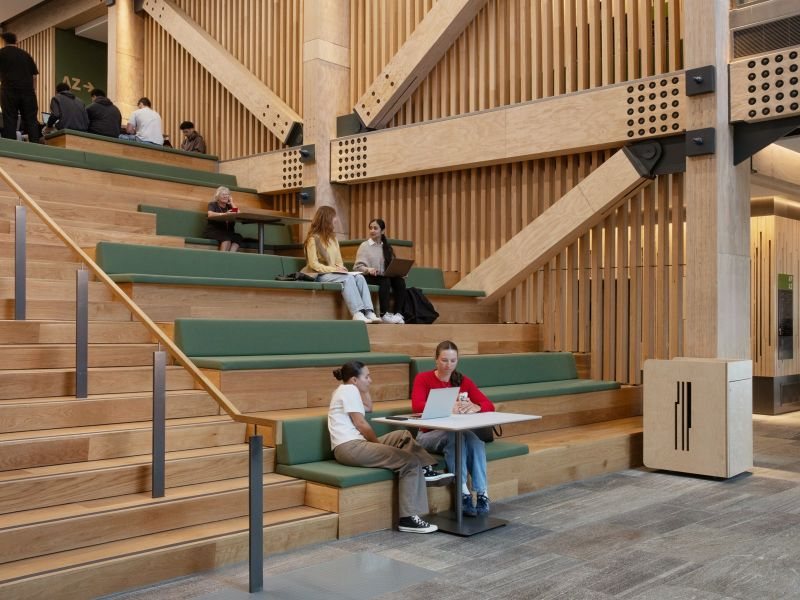
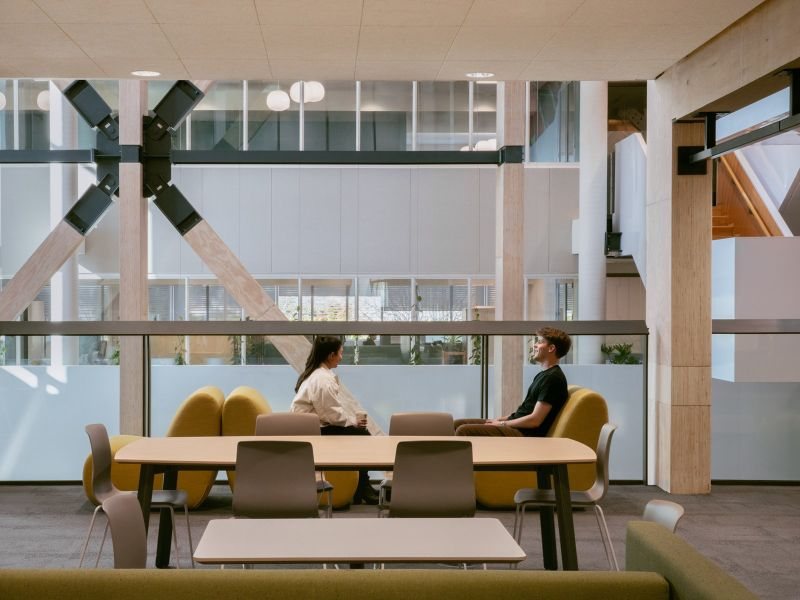
The note takes as its case Tukutuku, on the North Campus of AUT, which received an NZIA Auckland Architecture Award from Te Kāhui Whaihanga New Zealand Institute of Architects. Its timber structure and veiled façade are commitments to sustainability, wellbeing and place responsive design, and its name and form hold a conversation with the land, its people and the kaupapa of Aotearoa. Prof Ghaffarian reads the building as evidence of a shift in what a learning building should do. Rather than resisting remote learning, spaces like Tukutuku reassert the purpose of the physical.
The note identifies four functions. Such buildings anchor identity, so that students know whose place they are learning in. They build connection through stairs, edges and gathering spaces that invite people to stay. They give form to institutional values, making sustainability and cultural partnership visible rather than merely stated. And they host the informal, human scaled encounters through which people actually learn: the conversation after class, the chance meeting, the group that forms around a table. The closing line distils the argument: buildings like Tukutuku do not replace the virtual; they dignify the real.
A Research Record Built on Campuses
The authority of the perspective comes from the fact that university buildings have been one of the most consistent laboratories of Prof Ghaffarian’s research. With doctoral candidates and Professor Amirhosein Ghaffarianhoseini, he has studied indoor thermal comfort and occupants’ perception in university buildings in Auckland, published in Building Research and Information in 2025, and mapped summer outdoor thermal risk areas on a university campus in Auckland in Architectural Science Review. An earlier study of the thermal comfort of outdoor spaces on a university campus in Kuala Lumpur, in Science of the Total Environment, has been cited 160 times. In 2022 the group presented a digital twin of the AUT campus at the Construction Applications of Virtual Reality conference.
Doctoral supervision has carried the same inquiry into the rooms where learning happens. Tongrui Zhang’s thesis examined BIM and building management integration in a New Zealand educational building; Sameh Azzazy’s explored the effect of indoor thermal environments on users’ state of mind in educational buildings in Auckland; and Megan Burfoot’s developed intelligent passive acoustic technology for New Zealand classrooms, research shortlisted for the NZGBC Future Thinker Award in 2022. Prof Ghaffarian now leads an NZD 100,000 study, Incorporating Mental Health and AI in New Zealand Classrooms: A Neuroarchitecture Perspective (2025 to 2026), supported by a new neuroarchitecture virtual reality laboratory for sensory design and occupant wellbeing. When the note claims that buildings shape whether people stay, it speaks from measured evidence.
Culture, Place and the Learning Environment
Tukutuku’s dialogue with the land and with kaupapa Māori connects to a strand of Prof Ghaffarian’s work that is older than his career in New Zealand. In 2011 he was an author of Creating green culturally responsive intelligent buildings in Intelligent Buildings International, and in 2012 a study in the same journal on reducing cultural clashes among Malaysian youth through the architectural design of universities. Both treated cultural responsiveness as a design responsibility, and the second applied it directly to the university campus and to how diverse students experience belonging, more than a decade before hybrid learning. The note’s emphasis on identity is therefore the continuation of a long scholarly position, not a response to a single award.
That position has institutional expression at AUT. Prof Ghaffarian has represented the School on Te Kāhui Rangahau o Te Rōpū Taki Māori, the research subcommittee of the Faculty’s Māori staff caucus, since 2023, and in the same year led two AUT funded studies, totalling NZD 20,000, on the barriers faced by Māori and Pacific students in the School’s five bachelor programmes and on measures to raise their access and achievement. Under his headship the School is Education Partner for the 2027 global conference Indigenous Planning Reclaimed, alongside Ngāti Whātua Ōrākei as tangata whenua partner. A building that tells students whose place they are learning in is, in this light, one element of a wider commitment to equity of access.
Implications for University Leadership
Prof Ghaffarian wrote the note as Head of Department, Built Environment Engineering, and he now leads the School of Future Environments, whose departments of Architecture and Built Environment Engineering teach the people who will design and build the next generation of learning spaces. His leadership has applied the note’s logic to AUT City Campus by bringing the world to it. The School has hosted GDI 2025, SASBE 2024, IGLC32 and, in November 2025, FOSS4G 2025, with more than 400 attendees. Opening that conference, Prof Ghaffarian wrote that hosting it had allowed the School to show its spaces, culture and commitment to accessibility, sustainability, digital equity and open knowledge.
The age of AI gives the argument its urgency. As a member of the Artificial Intelligence Reference Group at the Office of the Prime Minister’s Chief Science Advisor since 2023 and an Associate Researcher at AUT’s Centre for AI Research since 2021, Prof Ghaffarian has led AI readiness work for the School’s staff, programmes and systems. The more that content becomes available everywhere, the more a campus must offer what content cannot: encounter, identity, mentoring and the experience of belonging to an intellectual community. The perspective is a reminder to university leaders and architects that investment in learning buildings should be judged by those outcomes. Readers may also turn to Prof Ghaffarian’s earlier essay How do buildings affect mental health? and to Comfort Is a Perception, Not a Number.