The Editorial Thesis
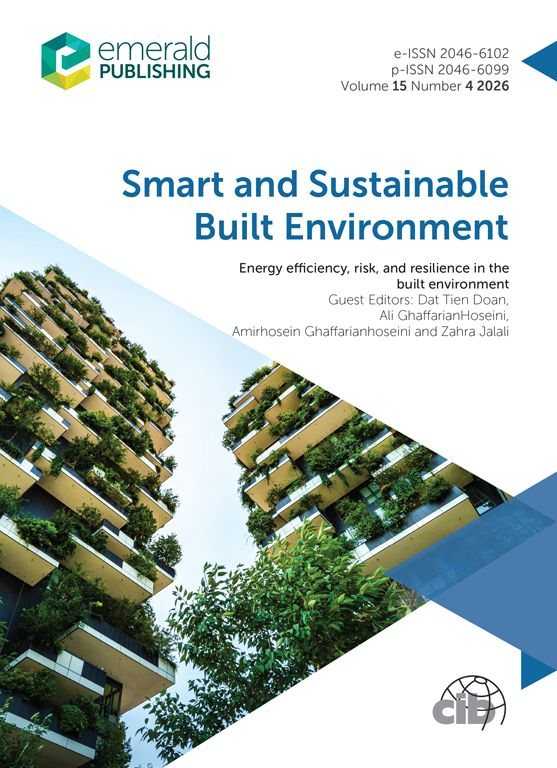
The special issue rests on a simple but demanding proposition: a building that saves energy yet fails in a heatwave, a flood or an earthquake has not served the people inside it. Energy efficiency asks how buildings and cities can use less; risk and resilience ask how they absorb shocks and keep functioning. For two decades the two agendas have often been pursued by different research communities, regulated under different codes and funded through different programmes. The editorial, Guest editorial: Energy efficiency, risk, and resilience in the built environment, published in volume 15, issue 4 of Smart and Sustainable Built Environment (pages 1413 to 1415), treats them as one design problem and gathers research that holds efficiency and resilience in the same frame.
The timing is deliberate. In 2026 the built environment faces rising expectations on carbon at the same moment as more frequent climate extremes, and New Zealand feels both pressures acutely: seismic exposure and a changing urban microclimate. An issue that asks how efficiency and resilience reinforce rather than undercut one another speaks directly to the decisions now facing designers, asset owners and regulators. It also reframes a familiar trade off. Measures that cut energy demand, from passive envelopes to urban greening, often reduce exposure to heat and supply disruption as well, while poorly judged efficiency can leave buildings brittle. The editorial asks researchers to show which is which, with evidence rather than assertion.
Professor Ghaffarian’s Editorial Leadership
The issue was guest edited by Dr Dat Tien Doan, Professor Ghaffarian, Professor Amirhosein Ghaffarianhoseini and Zahra Jalali. The composition of that team says a good deal about the editorial model Prof Ghaffarian has built. Dr Doan completed his doctorate under Prof Ghaffarian’s primary supervision in 2019, on improving Green Star certification through BIM uptake, supported by an AUT Vice Chancellor’s Doctoral Scholarship; Dr Jalali is the lead author of a critical review of New Zealand’s urban microclimate co-written with both Professors Ghaffarian in Energy and Buildings. A guest editorial team formed in this way is a visible outcome of a research school that trains scholars and then brings them into the editorial work of international journals.
The guest editors framed the call, screened submissions arising from SASBE 2024, managed peer review with the journal’s editors and judged which conference papers could carry the weight of full journal articles. The editorial was published in 2026, the year Prof Ghaffarian became Head of the School of Future Environments at AUT. It is one of eight journal special issues he has guest edited, a record that sits alongside current associate editorships of three international journals, among them Frontiers in Built Environment and the Journal of Housing and the Built Environment, and an earlier associate editorship of Architectural Science Review from 2021 to 2023.
From the Auckland Conference to the Journal Record
The papers originated at the International Conference of Smart and Sustainable Built Environment, SASBE 2024, which Prof Ghaffarian co-chaired with Professor Amirhosein Ghaffarianhoseini at AUT City Campus from 7 to 9 November 2024 in collaboration with CIB W116, the commission of CIB for smart and sustainable built environments. About 300 abstracts were received and 165 peer reviewed papers were published in the Springer Nature proceedings that Prof Ghaffarian led as editor (see the volume). Emerald’s Smart and Sustainable Built Environment was a named publishing partner of the conference from the outset, so this special issue completes a pathway designed before the first delegate arrived.
It is the third publication outcome of that conference, after the proceedings and the fifteen paper ITcon special issue. Its release was announced on LinkedIn together with the call for GDI 2026 and DigiBUILT 2026, the next stages of the conference series Prof Ghaffarian founded with Professor Amirhosein Ghaffarianhoseini, for which the same journal again serves as a publishing partner. The same issue of the journal also carries two articles he co-authored: a study by Pourel and colleagues on thermal comfort, daylight and outdoor microclimate in medium density housing and a study by Fahmi and colleagues on safe egress factors in hospital design, one on comfort and efficiency and the other on life safety.
The Research Agenda Behind the Issue
The editorial agenda grows out of Prof Ghaffarian’s most cited work. His review of the sustainable energy performances of green buildings in Renewable and Sustainable Energy Reviews has gathered 659 Google Scholar citations; the review of passive wall systems for energy efficiency has 402; and A Critical Comparison of Green Building Rating Systems, first authored by Dr Doan, has 966. Together they established much of the evidence on what efficient buildings achieve. The review of urban heat island mitigation strategies in Cities, with 577 citations, moved the same thinking to the scale of the city, where heat becomes a risk to health and to energy systems alike.
The resilience dimension has grown steadily alongside it. Prof Ghaffarian guest edited a 2024 special issue of Energy and Buildings on the role of built environment resilience in climate change alleviation, in association with The Hong Kong Polytechnic University and Toronto Metropolitan University. Recent work with his doctoral researchers and AUT colleagues includes a system dynamics framework for whole life costing in seismic and climate sensitive residential construction and a practitioner article for BRANZ on climate resilience with advanced data analytics. The editorial therefore reads as the convergence of two lines of a single research programme rather than a topic adopted for the occasion.
Standing and Consequence for the Field
Smart and Sustainable Built Environment is a Q1 Emerald journal and the publication most closely associated with CIB W116. Prof Ghaffarian’s relationship with it is long and substantive: his CV lists 21 journal articles in its pages since 2016, and he led its 2022 special issue on future construction. Returning as guest editor four years later, now as Head of School, places AUT among the institutions that shape the journal’s agenda rather than simply contribute to it. Editors are chosen because authors and reviewers trust their judgement, and that trust has now been extended to the same AUT team twice in one journal.
The consequence reaches beyond a single issue. For the authors, many of them early career researchers who first presented in Auckland, the issue converted conference papers into peer reviewed journal articles with international visibility. For the School, it confirms a publishing cycle in which every conference it hosts feeds the international literature. For practice, it offers designers and asset owners in New Zealand and abroad an evidence base in which efficiency gains are tested against the shocks buildings must survive, a test that national building policy will increasingly have to apply.